Robert Gutridge
Vice President of Global Business Units, Connected Living and Digital Commerce



Consider that just a decade ago (or less) someone would have been thought of as a bold futurist if they spoke of a world where ordinary people regularly used artificial intelligence in their daily routines. If they also suggested that human-looking robots called humanoids would be fulfilling taxing and tedious physical labor at the warehouse or helping them around the house they would likely have been met with disbelief. As it turns out, the future is now — or certainly, just around the corner.
"The next big thing is Physical AI, AI with a body.” – Jensen Huang, CEO of NVIDIA, at VivaTech 2025
Intentionally human looking in appearance, humanoids are advanced robotic machines enabled by sophisticated sensor, optics, and compute technology to perform tasks traditionally performed by humans. To be clear, however, humanoids are not a wholesale replacement of human workers on the factory floor or elsewhere. Their role is an additive one. By freeing people from arduous, low skill labor, humanoids empower the clever species that created them for higher value activities.
For the second consecutive year, Jabil has partnered with STIQ, an independent research firm specializing in global robotics and warehouse automation markets, on a report that tracks the humanoid sector’s evolution. This two-year perspective gives Jabil — and the customers we serve — a clearer, more current view of a market that is rapidly taking shape.
Annual surveys of workplace safety consistently rank lifting heavy loads and repetitive motions in their top 10 causes of costly and debilitating injuries. These types of tasks are also precisely the kinds of labor for which humanoids are ideally suited. In industrial applications, like warehouse operations, humanoids are a perfect fit for plugging in the gaps otherwise unmet by existing automated processes.
Humanoids' anthropomorphic design enables them to perform a variety of tasks, from picking and packing to machine tending and inspection. For logistics operators looking to streamline and modify workflows, particularly repetitive ones, humanoids are increasingly gaining traction as a potential solution.
Compared to current automation solutions, which are largely confined machines stuck on digital train tracks, humanoids offer broader task versatility — in a word, agility. Humanoids are also endowed by their creators with the capacity for autonomy, which means they are not reliant upon larger work site software and operational systems to function, like their cousins, automated guided vehicles (AGVs) and autonomous mobile robots (AMRs).
In early 2025, Jabil announced a unique collaboration with Apptronik, an Austin-based AI-powered humanoid robotics company, to help scale and accelerate production of its humanoid robot, Apollo. Jabil functions as both a manufacturing partner — building Apollo robots — and a test case, integrating Apollo into specific manufacturing operations on the factory floor. It’s an impressive demonstration of a modern manufacturing flywheel in action, where Jabil’s factory floors serve as both a production site for Apollo and a proving ground for informing the next generation of Apptronik robotics solutions.
For Apptronik, Jabil manufacturing sites provide an ideal real-world environment for validating Apollo’s capabilities across simple, repeatable intralogistics and manufacturing tasks. For Jabil, employees who had previously been focused on repetitive, physically demanding, or even dangerous work, can now be shifted to higher skill-level roles, as well as more creative, thought-intensive assignments.
Outside the structured environment of a manufacturing facility, such as in homes or healthcare settings, mastering agility is a tall order requiring more than just mechanical competency. Vision and language processing hurdles remain, and crossing these bars requires the integration and scaling of advanced optics, sensor, and compute technologies. But make no mistake, humanoids are coming to our homes. Even if they won’t be joining us for dinner, they’ll be terrific at cleaning up after it.
In 2025, STIQ’s analysis of the humanoid sector tracked roughly 50 companies. In its latest report, that number has expanded fivefold — an indication of how quickly the ecosystem is broadening across hardware, software, and component suppliers. For its 2026 report, STIQ tracked more than 250 humanoid-focused companies globally. Alongside this expansion, public funding in the sector approached $5 billion in 2025, and the number of vendors announcing a humanoid or related software offering doubled year over year.
Featured within STIQ’s annual reporting is a framework for understanding humanoid autonomy levels. At the simplest end (H1), systems resemble humans in form but lack full mobility, while at the other extreme (H5), the concept approaches a synthetic human that is difficult to distinguish from the real thing. The industry today sits somewhere between H1 and H2. Progressing further will require continued advances across both mechatronics and software — and, at higher levels, capabilities that are still emerging.
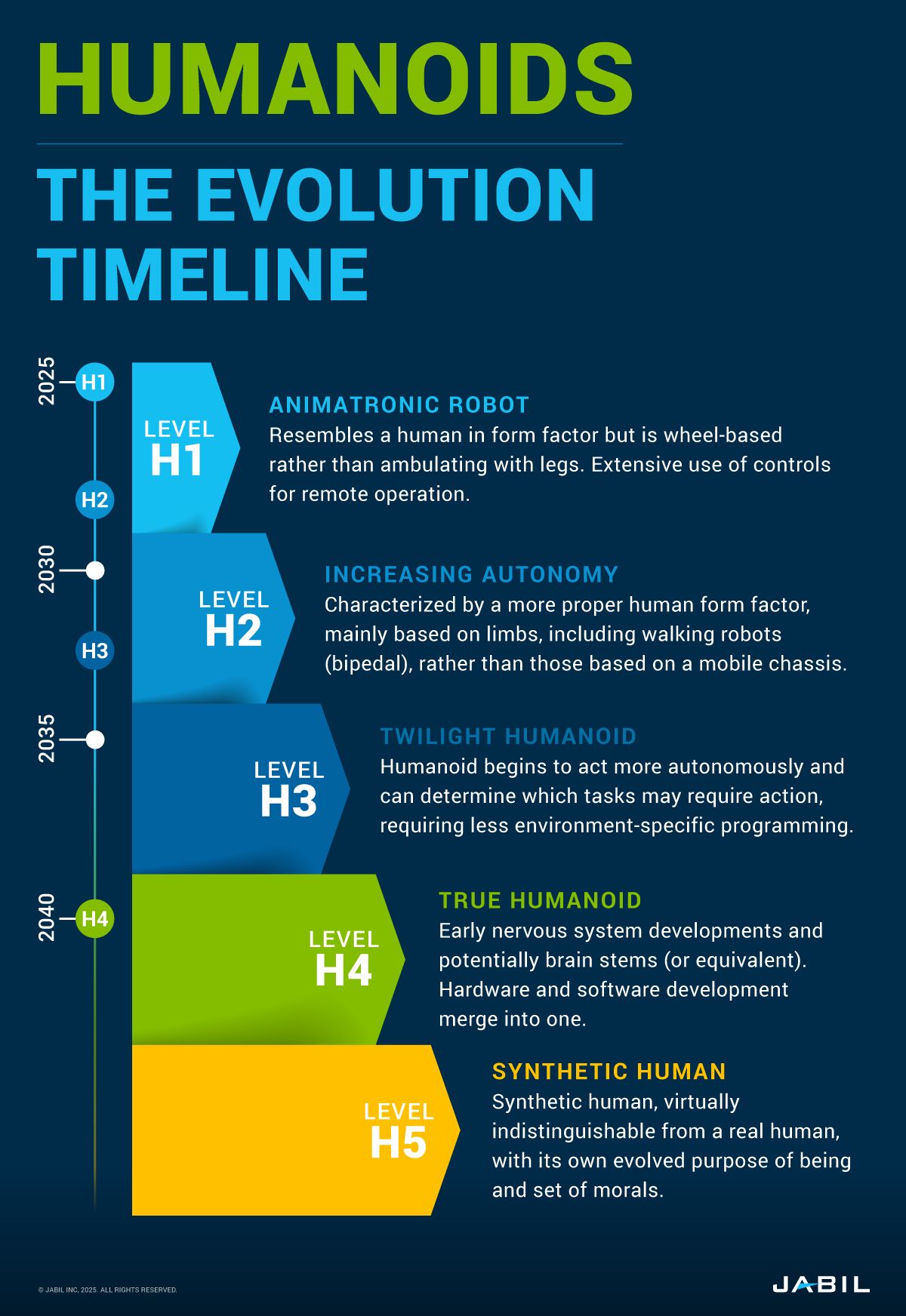
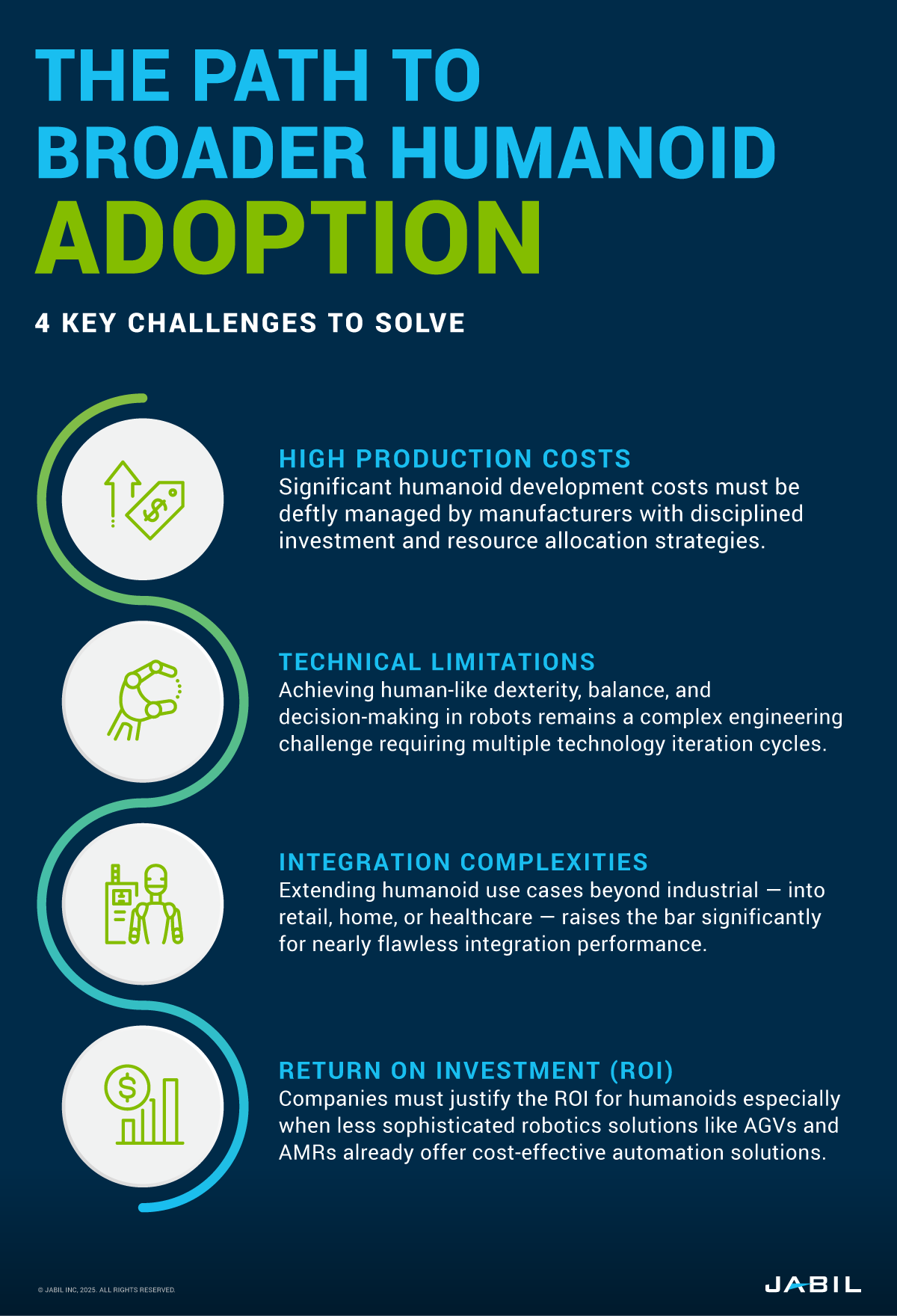
Despite the promising potential, several challenges remain before the market can meet more optimistic forecasts. Humanoids at H1 and H2 are already highly complex aggregations of technologies and components. Reducing bill of materials (BOM) and manufacturing costs, while expanding use cases and accelerating time to market will be critical.
At the same time, the path to scale depends on how quickly practical use cases are validated. To move beyond novelty, humanoids need to demonstrate consistent, reliable performance in real-world environments. Broader adoption will follow as capabilities align more closely with specific operational needs, helping to clarify where humanoids can deliver sustained value. Put simply, the near-term outlook comes down to two questions: can humanoids be made economically viable, and where will they prove their value first?
The path to that inflection point, however, runs through a more crowded field than existed just twelve months ago. In the United States, the AI-powered humanoid market is being shaped by established players like Tesla and Boston Dynamics, alongside high-valuation startups like Figure, Apptronik, and Agility Robotics. Globally, however, of the 250 humanoid ecosystem companies currently tracked by STIQ, approximately 60% are based in Asia, with a significant concentration in China.
The broader ecosystem supporting the sector has also been highly dynamic. STIQ notes that over the last year, there has been an influx of component suppliers as vendors pivot toward component sales as an alternative revenue stream to buffer their complete robot sales. And in terms of where the seeds of innovation may grow next, STIQ reports that Chinese vendors appear far more active in filing patents compared to North American and European vendors.
Yet whatever potential unknowns currently define the sector, a recent report from Barclays Research cites breakthroughs in three key areas — AI reasoning (“brains”), actuator technology (“brawn”), and battery systems — as driving increasing volumes of venture capital and corporate investment well into the future. As AI moves from software into physical form, Barclays projects a humanoid robotics market of $200 billion by 2035.
Morgan Stanley’s Adam Jonas — best known for his early and influential coverage of Tesla and the EV sector, and now leading the firm’s embodied AI strategy — has similarly pointed to the scale of the opportunity, describing AI-enabled robotics as a catalyst for a new industrial era, with the potential to underpin a robot economy measured in the tens of trillions of dollars in the decades ahead.
Download STIQ's Humanoids 2026 Report
One of the more consequential developments in STIQ’s 2026 research is the identification and emergence of four distinct humanoid market segments — a meaningful evolution from the broadly defined “industrial vs. consumer” framing of 2025.
STIQ’s now categorizes the emerging humanoid landscape as follows:
| Segment | Primary Use | Payload/Level | Key Considerations |
|---|---|---|---|
| Toy/Entertainment | Companion for children; B2B entertainment events | < 3kg/H1–H2 | Plug-and-play; child safety standards; high personalization potential |
| Butler | Home chores, elder care, emotional companion | < 20kg/H2–H4 | Privacy and safety paramount; integration with home ecosystems critical |
| Light Industrial ("Titan") | Warehouse, light manufacturing, intralogistics | < 50kg/H2–H3 | RaaS models likely; stiff incumbent competition from cobots and AMRs |
| Heavy Industrial ("Goliath") | Construction, shipbuilding, heavy lifting | > 100kg/H3+ | Remote/teleoperated initially; trained operators required |
The Light Industrial and Butler segments currently attract the lion’s share of vendor activity, while Heavy Industrial humanoids remain at an earlier stage of market development. Understanding the varied technology requirements and supplier dynamics across humanoid’s use case spectrum is increasingly important context for any company seeking to keep pace with the sector’s leaders setting the bar for innovation and performance.
The trends emerging from STIQ’s humanoid research are being echoed in the wider physical robotics and automation sector. In March 2026, Amazon acquired Rivr, a Zurich-based startup whose quadruped robot has been a pioneer in general physical AI deployment in challenging urban environments. This is a strategic move by the world’s largest e-commerce operator to leverage physical AI to solve last-yard logistics challenges (like climbing stairs) that wheeled autonomous mobile robots (AMRs) alone cannot address. It’s also a clear demonstration that the quadruped form factor — once dismissed as too complex or niche — has enough promise of real-world utility to attract significant investment. Not later, but now.
Meanwhile, Boston Dynamics, whose Atlas humanoid platform made a splash at CES 2026, is undergoing one of the most significant valuation re-ratings in robotics history. Acquired by Hyundai Motor Group in June 2021 at a company valuation of $1.1 billion, Boston Dynamics is now reported to be worth more than $20 billion, according to coverage in the Korea Herald, following its impressive CES audition. Whether or not that transaction materializes in the near term, the attention it commands underscores how quickly investor interest is coalescing around robotics companies with proven hardware platforms and commercial deployment track records.
For Jabil customers navigating this landscape, the pattern is clear: the window between early-stage proof-of-concept and strategic scale-up is compressing. As humanoid development accelerates, the ability to move from prototype to production with speed and consistency is becoming a defining advantage.
In a sector where hundreds of vendors are competing for commercial traction, the differentiator is no longer just technological innovation, but the ability to translate that innovation into manufacturable, cost-effective products at scale.
As the humanoid robotics industry expands into broader use cases, partnering with a company that possesses technical prowess, global manufacturing capabilities, and trusted supplier relationships is crucial. The best manufacturing partnerships also provide inventory management, design for manufacturing (DfM) expertise, turnkey procurement, and a comprehensive view of a company’s existing supply chain across the entire product lifecycle.
Two years ago, describing humanoids as a transformative technology required a degree of forward optimism. Today, it requires discipline. The market is taking shape, investment is accelerating, and expectations are becoming more concrete. Jabil’s ongoing work with partners like STIQ reflects a focus on helping customers navigate that shift — bringing clarity to a rapidly evolving landscape and supporting the path from emerging technology to real-world deployment.
Explore how humanoid robotics are set to transform our day-to-day lives and gain deeper insights into the future of automation by downloading our comprehensive report produced in collaboration with our research partner STIQ.
This detailed analysis offers valuable information on market trends, technological advancements, and strategic implementations of humanoid robots in a wide range of industries.